
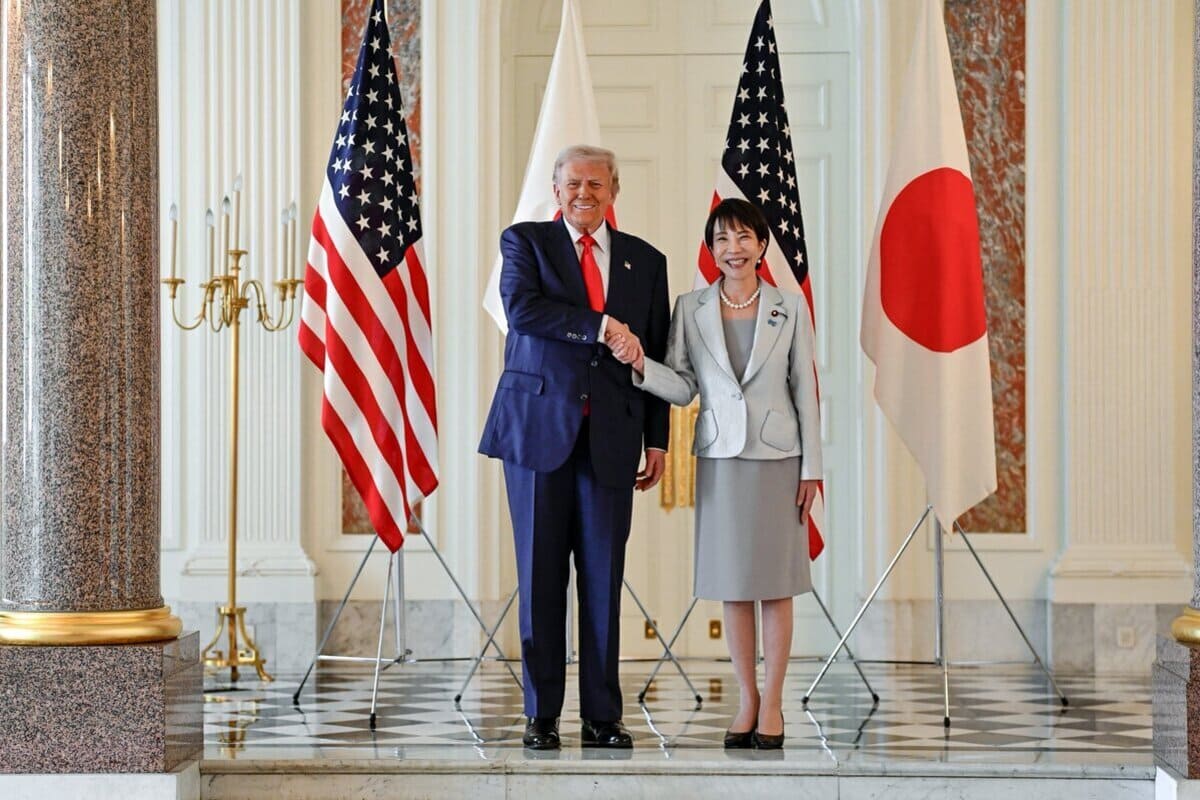
TOKYO – In a significant diplomatic engagement, former U.S. President Donald Trump and Japan’s new Prime Minister Takayichi convened in Tokyo this week, signaling a powerful reinforcement of their nations’ security and economic partnership. The meeting, which included the signing of a key agreement and a symbolic address aboard a U.S. aircraft carrier, highlighted both the enduring strength and future challenges of the alliance.
The discussions between Trump and Takayichi, who recently made history as Japan’s first female leader, were described as overwhelmingly positive. Trump praised his counterpart as “a winner,” pointing to concurrent all-time highs in both American and Japanese stock markets as evidence of effective governance.
A cornerstone of the initial talks was the formal signing of a framework deal on the supply of critical minerals and rare earth elements. Analysts view this agreement as strategically vital, reducing both nations’ reliance on a single source for these components essential to modern technology, from smartphones to military equipment.
The symbolism of the alliance was further amplified when the two leaders delivered a joint speech to U.S. sailors aboard the USS George Washington. Trump characterized the U.S.-Japan bond as “one of the most remarkable relationships in the entire world,” a “foundation of peace and security in the Pacific” born from the aftermath of World War II and solidified over eight decades.
Observers noted that the spirit of the late Prime Minister Shinzo Abe loomed large over the proceedings. Both Trump and Takayichi shared a close relationship with Abe, providing a foundation of established trust that facilitated their first official meeting.
Despite the public display of unity, the path forward involves navigating complex economic negotiations. The U.S. is expected to push for greater access to Japanese markets, particularly in the automotive and agricultural sectors. This presents a delicate balancing act for Prime Minister Takayichi, who must safeguard domestic industries while managing the crucial relationship with Washington.
The issue of auto tariffs is especially sensitive given the current weakness of the Japanese yen, which affects the competitive landscape for car manufacturers. While Trump’s push for Japan to purchase more American cars remains a point of discussion, the record-breaking performance of Japan’s Nikkei stock index is seen as a positive economic indicator that could influence future trade discussions.
The visit successfully projects an image of a solidified and strengthened alliance, ready to address shared security concerns in the Asia-Pacific. However, the upcoming trade negotiations will be the true test of this renewed “beautiful friendship,” as both leaders work to translate diplomatic goodwill into mutually beneficial economic terms.