
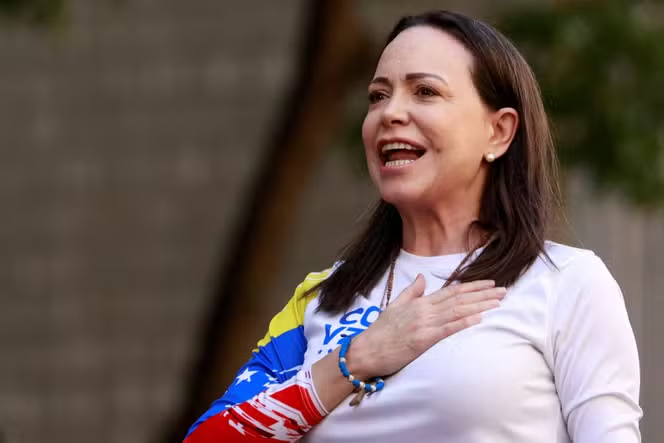
Maria Corina Machado, Venezuela’s opposition leader, has been given the 2025 Nobel Peace Prize by the Norwegian Nobel Committee, causing vibrations across the worldwide political landscape. The decision, made in Oslo, recognizes her “tireless work promoting democratic rights for the people of Venezuela and her struggle to achieve a just and peaceful transition from dictatorship.”
Many outside observers may regard this as a clear prize for a pro-democracy campaigner. However, for Venezuelans and those who have witnessed the country’s terrible slide from wealth to calamity, this award is a significant and symbolic gesture. It is more than just an individual honor; it is an acknowledgment of a people’s two-decade battle and a strategic boost for a very specific type of courage—the courage of peaceful, unyielding resistance.
The Backdrop: A Nation in Agony
To understand the significance of Machado’s honor, one must first comprehend the gravity of Venezuela’s dilemma. This is more than just a political disagreement; it is the methodical dissolution of a once-rich nation.
- From Riches to Ruin: In the early 2000s, Venezuela was South America’s wealthiest country, buoyed by the world’s largest proven oil reserves. Today, hyperinflation has rendered its currency nearly worthless. The International Monetary Fund (IMF) has documented one of the most severe economic contractions in modern history outside of war, with GDP plummeting by over 80% since 2013.
- A Humanitarian Catastrophe: The human cost is staggering. The UN High Commissioner for Human Rights has repeatedly highlighted the collapse of basic services. Once-proud hospitals lack running water, antibiotics, and electricity. According to a 2023 study by a leading Venezuelan university, over 90% of the population lives in poverty, with malnutrition affecting a generation of children.
- The Erosion of Democracy:
This economic freefall was engineered by a political one. Under the regimes of Hugo Chávez and his successor, Nicolás Maduro, institutions were systematically gutted. The Supreme Court was packed with loyalists, the powers of the opposition-led National Assembly were neutered, and elections have been widely condemned as fraudulent. Political repression became the norm, with groups like Foro Penal documenting thousands of political prisoners and cases of torture over the years.
It is in this cauldron of despair that Maria Corina Machado’s story unfolds.
Who is Maria Corina Machado? More Than Just an Opponent
Machado is not a newcomer to the fight. An industrial engineer by training, she entered politics in the early 2000s, first as a civil society leader. She co-founded Súmate, a grassroots organization focused on electoral transparency, which immediately put her on a collision course with the Chávez government.
What distinguishes Machado in a fractured opposition landscape is her consistency and her strategy. While other opposition figures have fluctuated, negotiated, or been co-opted, Machado has maintained a clear, principled stance: the regime is an illegitimate dictatorship, and change must come through peaceful, constitutional, and electoral means.
Her “tireless work”, as cited by the Nobel Committee, has taken many forms:
- The Electoral Route: Despite being disqualified from holding public office by the Maduro government on politically motivated charges, Machado did not call for armed rebellion. Instead, she doubled down on the democratic process. In 2023, she won the opposition primary election in a landslide victory, a clear testament to her popular mandate. Her campaign was a masterclass in grassroots mobilization, energizing a population weary of both the regime and a seemingly ineffective opposition.
- A Unifying Figure (For Some): Machado has managed to become a rallying point for a broad coalition of Venezuelans, from students and the middle class to the impoverished masses who once supported Chavismo. Her message centers not on nostalgic revenge but on a tangible future—rebuilding the economy, restoring institutions, and healing a traumatized society.
- International Advocacy: She has been a constant voice on the international stage, eloquently articulating the Venezuelan crisis to bodies like the Organization of American States (OAS) and the UN Human Rights Council. She didn’t just ask for sympathy; she argued for targeted pressure on the regime while championing humanitarian aid for the people.
The Deeper Meaning of the Prize: A Strategic and Moral Statement
- The Nobel Committee’s decisions are never made in a vacuum. Awarding the prize to Machado in 2025 is a deeply strategic act with several layers of meaning.
- A Shield and a Megaphone: The prize provides Machado with an unparalleled platform and a layer of protection. It internationalizes her cause to an even greater degree, making any direct move against her by the Maduro regime a far more costly proposition. It’s a megaphone that ensures the world cannot look away from Venezuela.
- Legitimizing the Peaceful Struggle: In a region where political instability can sometimes lead to violence, the Committee is making a powerful statement: peaceful, democratic resistance is the only legitimate path. It reinforces the idea that Machado’s method—the ballot box, civil disobedience, and unwavering principle—is the one worthy of the world’s highest peace accolade.
- A Message to the World: This award is also a critique of the international community’s often-lukewarm response. It’s a reminder that while democracies debated and imposed half-measures, a woman and her millions of followers were on the front lines, risking everything for the values the West claims to hold dear. As one European diplomat anonymously noted, “This prize forces everyone to pick a side. Neutrality is no longer a comfortable option.”
The Road Ahead: From Symbolism to Solution
While the Nobel Peace Prize is a monumental boost, it does not, in itself, remove Maduro from power or fix Venezuela’s broken infrastructure. The challenges remain Herculean.
The regime will likely dismiss the award as “imperialist interference.” Machado’s internal challenges—uniting a still-fractured opposition and maintaining momentum in the face of brutal repression—are immense. The practical work of negotiating a transition, securing free and fair elections, and managing the expectations of a suffering populace lies ahead.
Yet, the prize changes the calculus. It injects new energy into a weary movement. It gives hope to the mother who cannot find baby formula, to the doctor working without power, to the student jailed for protesting. It tells them that their struggle is seen, and that their chosen leader stands among the global pantheon of peacemakers like Aung San Suu Kyi and Nelson Mandela.
Conclusion: An Award for the Venezuelan People
In the end, the 2025 Nobel Peace Prize, while bestowed upon Maria Corina Machado, is ultimately a tribute to the enduring spirit of the Venezuelan people. It recognizes that in the face of overwhelming odds, the most powerful weapon can be a steadfast refusal to surrender one’s dignity and democratic rights.
Machado’s story is still being written. The road to a “just and peaceful transition” is long and fraught with peril. But with this award, the world has not just honored a leader; it has thrown a spotlight on a nation’s fight for its own soul. It has declared, in no uncertain terms, that the quest for freedom in Venezuela is one of the defining moral struggles of our time, and that Maria Corina Machado is its most resonant and courageous voice.