
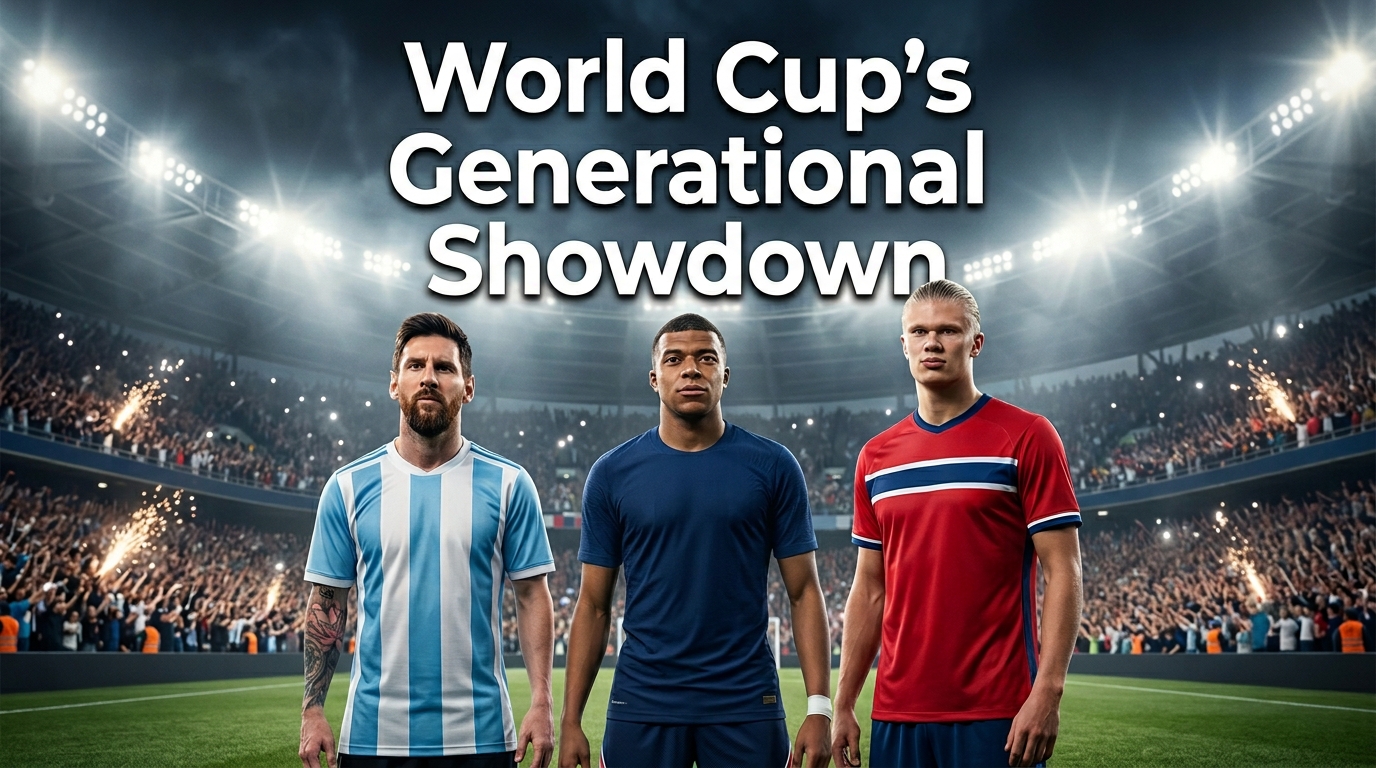
For all the talk about expanded formats, new host cities, and the commercial size of the 2026 World Cup, the tournament still bends toward the oldest truth in sport: the biggest players decide the biggest moments.
On Monday, that truth arrived in three different forms.
Lionel Messi, still refusing to let time close the curtain on him, scored twice for Argentina and moved deeper into football history. Kylian Mbappé did what he has done since he was a teenager on this stage, turning a World Cup match into a personal runway. Erling Haaland, playing for a Norway side that has long lived outside the tournament’s elite conversation, gave his country the kind of cutting edge that can change national expectations overnight.
Three superstars. Three braces. Three very different meanings.
This was not simply a day of goals. It was a snapshot of where the modern game stands: one legend stretching the limits of longevity, one heir apparent accelerating toward records once thought untouchable, and one brutal finisher dragging a smaller football nation into a bigger future.
For Messi, Argentina’s win over Austria carried the feel of another entry in a career that has already run out of normal adjectives. At 38, he is no longer supposed to be doing this. World Cups are usually where aging greats are exposed, not where they rewrite the record book. The pace is sharper, the travel is heavier, the recovery windows are crueler, and opponents are rarely sentimental.
Yet Messi keeps finding space where there should be none.
His latest goals matter not only because they pushed him to the top of the World Cup scoring list, but because of what they say about adaptation. The young Messi was a blur of balance and acceleration. The late-career Messi is something more forensic. He does not need to dominate every yard of grass. He waits, studies, conserves, and then appears in the one place defenders cannot afford to lose him.
That is what makes Argentina dangerous again. They are not merely carrying an icon through a ceremonial farewell. They still have a player who can decide knockout football, and the emotional force around him remains enormous. For opponents, that is a tactical problem. For Argentina, it is almost spiritual fuel.
Mbappé’s performance for France belongs to a different category. His story is not about defying age. It is about inevitability.
France’s victory over Iraq reinforced the sense that Mbappé is not chasing greatness from the outside anymore. He is already inside the room, moving furniture around. His World Cup record is becoming absurdly efficient, and at 27, he has time on his side in a way Messi no longer does. Every goal now carries a second meaning: the immediate value to France and the long-term pressure it applies to football history.
What separates Mbappé is how repeatable his threat feels. Some players need a match to open up. Some need a perfect pass, a defensive mistake, or a broken sequence. Mbappé can manufacture panic from ordinary positions. Give him grass and he turns defenders toward their own goal. Give him half a yard and he shoots before the goalkeeper has finished setting his feet.
France will know, however, that Mbappé’s brilliance also raises a familiar question. Are they becoming too dependent on moments of individual superiority, or are those moments simply the natural privilege of having one of the best players in the world? Tournament football often rewards both structure and stardust. France has plenty of both, but the deeper they go, the more opponents will build entire plans around making someone other than Mbappé beat them.
Then there is Haaland, whose World Cup arc feels almost separate from the Messi-Mbappé record chase.
Haaland has never needed a World Cup to prove he is one of the most devastating scorers alive. His club career has already done that. But international tournaments confer a different kind of legitimacy. They create images that travel beyond fan bases and league loyalties. For players from countries outside the usual finalist class, they can also redefine what is considered possible.
Norway’s win over Senegal was exactly that kind of moment.
Haaland’s two goals were not just personal statistics. They were national leverage. Norway, absent from the World Cup for decades, now has a team capable of making noise because it has the rarest commodity in football: a striker who can turn limited chances into permanent damage. In a competition where one mistake can end a campaign, that changes how every opponent must prepare.
The wider significance is hard to miss, especially for audiences in the United States, Canada, and the United Kingdom. This World Cup is not only a sporting event; it is a month-long test of football’s cultural reach across North America. Expanded fields can create more stories, but they can also dilute attention if casual viewers feel overwhelmed by fixtures and unfamiliar teams. Star power solves that problem. Messi, Mbappé and Haaland are not just players in this context. They are entry points.
Messi brings memories. Mbappé brings the present tense of elite European football. Haaland brings the algorithmic thrill of goalscoring at its most direct. Together, they give the tournament a narrative spine.
That matters for broadcasters, sponsors, host cities, and the sport’s long-term growth in markets where football competes with the NFL, NBA, MLB, and NHL for attention. A World Cup in North America needs packed stadiums, yes, but it also needs moments that cut through beyond traditional soccer audiences. A Messi record does that. A Mbappé chase does that. A Haaland-led Norway run does that.
The football implications are just as compelling.
Argentina now looks less like defending champions trying to manage an aging talisman and more like a side still capable of bending the emotional temperature of the tournament. France remains one of the clearest title threats, with Mbappé’s record pursuit adding menace to an already deep squad. Norway, meanwhile, has moved from interesting outsider to potential knockout nuisance — the kind of team no favorite wants to see when margins shrink.
The next phase will test whether Monday was a highlight reel or a warning.
In group play, stars can overwhelm weaker structures. In knockout football, opponents become more cynical, space becomes more expensive, and every touch near the box carries a heavier consequence. Messi will be asked to keep cheating time. Mbappé will be asked to carry the expectation without impatience. Haaland will be asked to prove that Norway’s rise is more than a group-stage surge.
That is the beauty of this particular World Cup moment. It is not one story. It is three timelines colliding.
Messi is protecting the past while somehow still shaping the present. Mbappé is hunting the future faster than anyone expected. Haaland is trying to build a new national chapter with the blunt force of goals.
For one day, at least, the expanded World Cup did not feel too big or too scattered. It felt focused, dramatic, and unmistakably elite.
The superstars took the stage, and the tournament suddenly had its pulse.
Great content! Keep up the good work!
Thanks!